
Joseph Bologne Was Never Lost
For two centuries there was always a reason not to programme Joseph Bologne's music. Last week, the Catalyst Quartet quietly took the reason away.

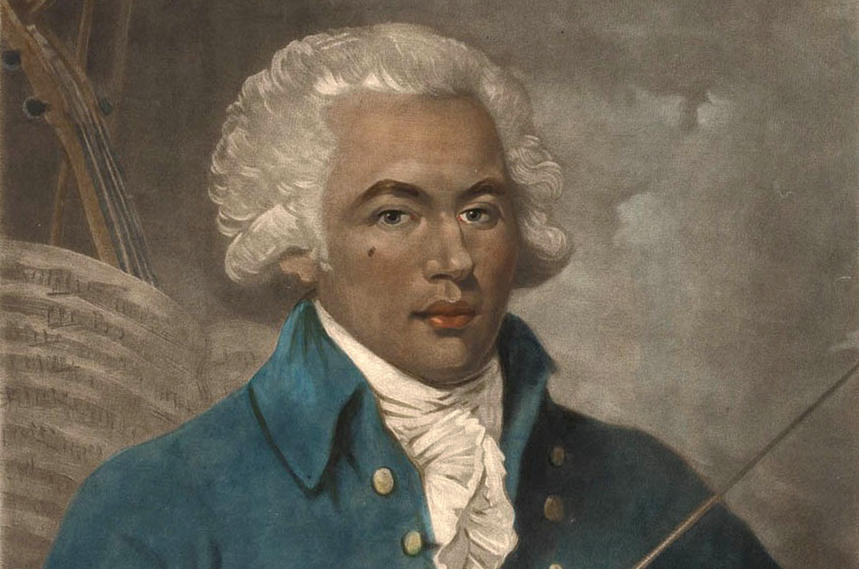
Eighteen string quartets, three sets of six written across a working life, and until last week not one of them had ever been recorded as a complete set. The composer is Joseph Bologne, Chevalier de Saint-Georges, and the strange thing is that he was once one of the most famous men in Paris.
Bologne was not a minor figure waiting to be discovered. In his own Paris he was a celebrity: a violinist people crossed the city to hear, a fencer they paid to watch, a fixture of the most fashionable rooms in Europe. He was born in Guadeloupe in 1745 to an enslaved Senegalese woman and a French planter. When his name came up to run the Paris Opéra, some of its leading singers objected in writing to being led by a man of colour, and he didn't get the post. He kept composing anyway.
Here is the part that should land for anyone who has ever stood in front of an orchestra. Bologne was a conductor. When his mentor Gossec moved on, he took over the Concert des Amateurs, one of the finest orchestras in Europe, and led it from the first violin desk, the way conducting was done before the baton. Later he founded his own orchestra, the Concert de la Loge Olympique, and it was for that ensemble that he commissioned Haydn to write the six Paris symphonies. Read that again. The reason some of Haydn's greatest orchestral music exists is a man most concertgoers have never heard of.
For two centuries the reason his music sat unplayed was always the same, even when nobody said it aloud. You cannot programme what you cannot get your hands on. The scores were scattered, the parts unreliable, the recordings nonexistent. It was never a satisfying excuse, but it was an excuse.
That excuse is now gone. The GRAMMY-nominated Catalyst Quartet has released UNCOVERED Volume 4 on Azica Records, the closing chapter of an anthology that has already recovered Samuel Coleridge-Taylor, Florence Price, and Valerie Coleman. This volume sets down all eighteen Bologne quartets, complete, for the first time anyone can buy. The playing is not an act of charity. The music is galant, warm, supple, written by someone who plainly enjoyed the company of three other instruments.
And the quartets are only the part we can now hear in full. The man also left around a dozen violin concertos, two symphonies, and a stack of symphonies concertantes, the hybrid form he helped make fashionable in Paris. Any conductor could put those on a programme tomorrow. So the only thing standing between Bologne and the orchestra he once led is a choice. The canon was never a natural formation, some sediment that settled on its own. People decided what stayed in the room and what got filed away, and the man who handed Haydn those commissions got filed away.
Eighteen quartets, finally in one place. The orchestral music is still sitting there, waiting for a conductor to make the same decision.
Photo: Portrait of Joseph Bologne, Chevalier de Saint-Georges; painted by Mather Brown, engraved by William Ward, 1788. Public domain via Wikimedia Commons